

These are parts of the presentation at ASA FDA workshop 2021. The full content can be obtained upon request.
Heart Failure Phenotyping by Latent Class Analysis Identifies Subpopulations at High Risk of Mortality and Readmissions: Insights from a Real World Database
A poster presented at an ACC annual conference
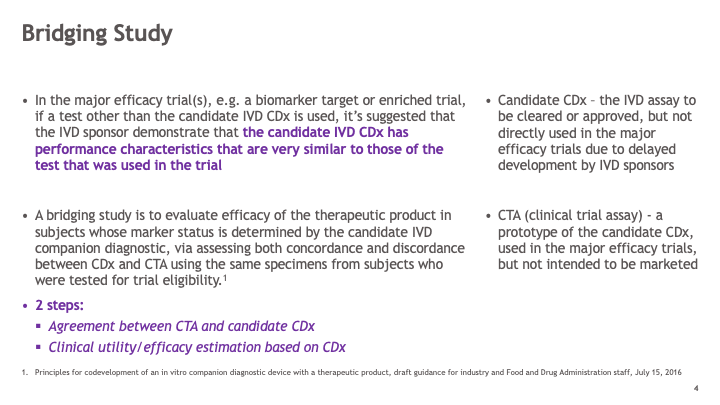
Incorporate Real World Evidence in an IVD Bridging Study for Joint Submission of Therapeutic and Companion Diagnostic Products →



Bayesian Mixed Effects Modeling for Repeated Measures Using Stan
The below is a part of a poster presented in the past. The full content can be obtained upon request.

Prognosis vs. Prediction in Precision Medicine
Prognostic Biomarker: provides information about the patients’ overall outcome, regardless of therapy.
Statistical test: is Marker X associated with an efficacy endpoint?
Predictive Biomarker: provides information about the effect of a therapeutic intervention; can be a target for therapy
Statistical test: is Marker X associated with the differential effect between treatments on an efficacy endpoint (treatment comparison)

Graphic illustration of prognostic and predictive biomarkers.
Statistical methods to evaluate a biomarker’s prognosis and prediction.

Clinical trial designs based on prognostic and predictive biomarkers
Prognostic Enrichment: to identify patients with a greater likelihood of having the event (or a large change in a continuous measure) of interest in a trial
Advantages: to increase the power of a study to detect any given level of risk reduction.
Predictive Enrichment: to identify patients more likely to respond to a particular intervention
Advantages: to better detect increased study efficiency or feasibility, or enhanced benefit-risk relationship
Define fit-for-purpose threshold on a biomarker with a continuous scale
To determine the optimization goal:
the maximized differentiation in an outcome between marker selected and the un-selection populations by the cutoff
the maximized or a targeted differentiation between treatments in a marker selected the population
the maximized interaction effect between treatment and a categorized biomarker
a target efficacy outcome, e.g. response rate, median survival
an optimal sensitivity and specificity combination, e.g. Youden index by ROC
prevalence consideration
concordance with a reference biomarker