
Bayesian Methods and Trial Designs
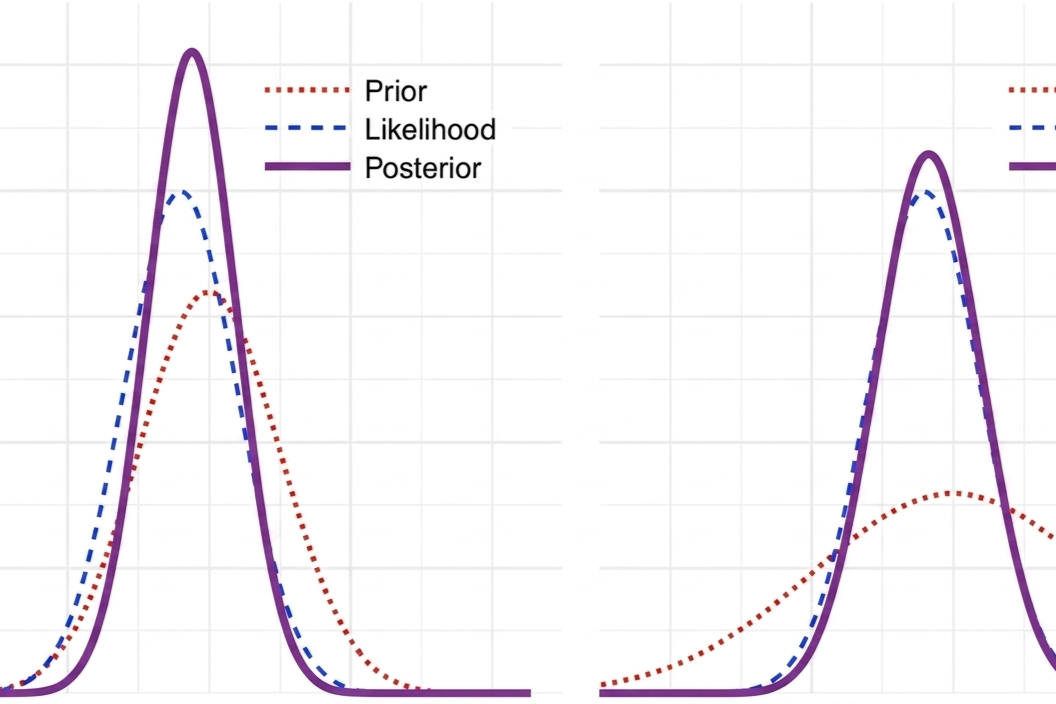
Graphic presentation of the impact of a prior distribution on the posterior distribution given the identical likelihood function.
Bayesian Methods in Clinical Development
In clinical development, the use of Bayesian methods can be embedded throughout the development lifecycle of a drug or biologic. The examples can be seen in early phase dose finding trials, clinical trial planning in late phase studies, registrational trials in pediatrics or rare diseases, observational studies and more. The recently published guidance by FDA, EMA, and other global agencies indicates that the regulatory decision-making is steadily shifting from sole reliance on p-values to a more comprehensive decision frameworks. Here are some blogs with topics surrounding the methodology.
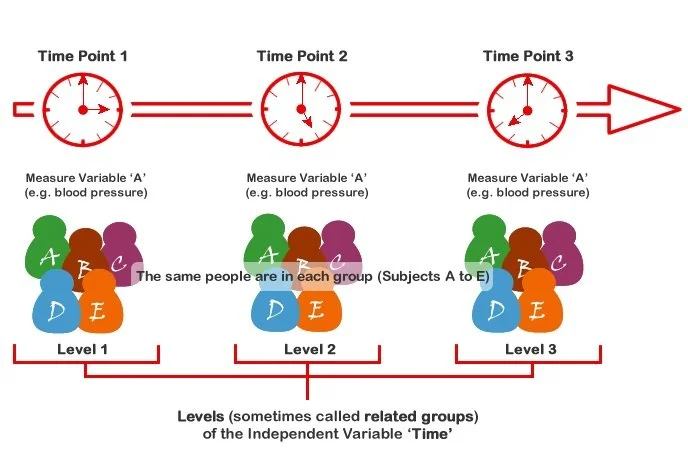
Graphic illustration of repeated measures that were assessed over time.
Bayesian Mixed Effects Modeling for Repeated Measures
Repeated measures are characterized by multiple observations on same sampling units, such as longitudinal assessments taken over time or multiple assessments over space. Mixed effects models for repeated measures can be widely applied to bioequivalence studies, clinical trials, observational studies, monitoring biomarker assessments, PK/PD, drug safety, or discovery space. The model typically requires specification of both fixed and random effects parameters and impose covariance structures considering that observations from the same unit are likely correlated. In Bayesian framework, it is challenging to construct the covariance matrices utilized in frequentists modeling when using the earlier computational tools such as BUGS because of certain limitations in generating multivariate distributions. Recent advancements in Bayesian tools, such as Stan and PROC MCMC in SAS, implement built-in functions to generate multivariate distributions that offer an opportunity to construct covariance matrices directly.
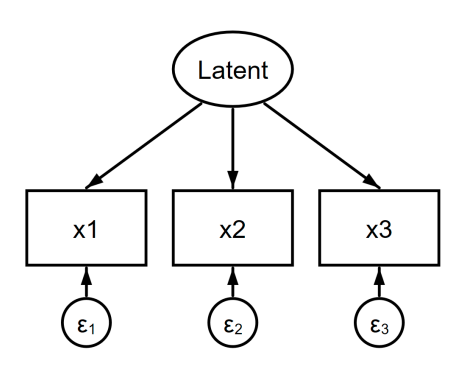
Graphic illustration of a latent measurement.
Latent Class Analysis - Model Based Clustering
Model-based clustering, assuming subgroups from a finite mixture distribution, and group membership determined by maximizing the posterior probability in one of the pre-specified number of subgroups with a Bayesian rule.
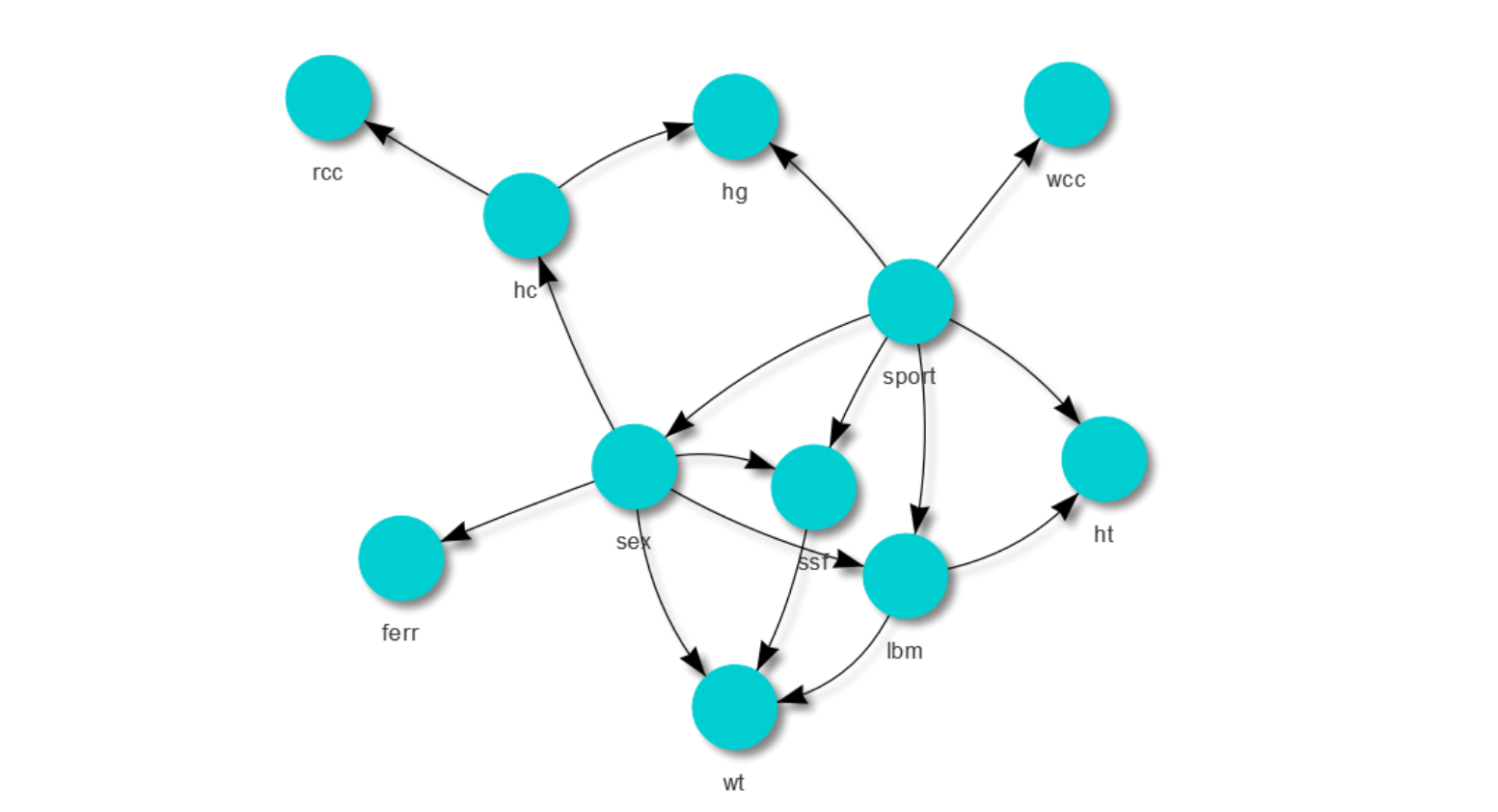
Graphic illustration of a Bayesian network.